A complete shed materials list helps you turn a set of drawings into a practical shopping plan. It should tell you what to buy, how much you need, and which specifications matter.
Without that information, it is easy to come home with plenty of lumber but discover that you are missing the connectors, roof edging, or door hardware needed to finish the next stage.
The best starting point is the materials list for your exact shed design. Use this guide to check its completeness and organize your purchases—not as a substitute for the quantities and structural specifications in your plans.
This article contains affiliate links. If you purchase through them, we may earn a commission at no additional cost to you.
Looking for a plan to build from? Explore My Shed Plans. Check the sample drawings and confirm what materials information is provided for the particular design you want.
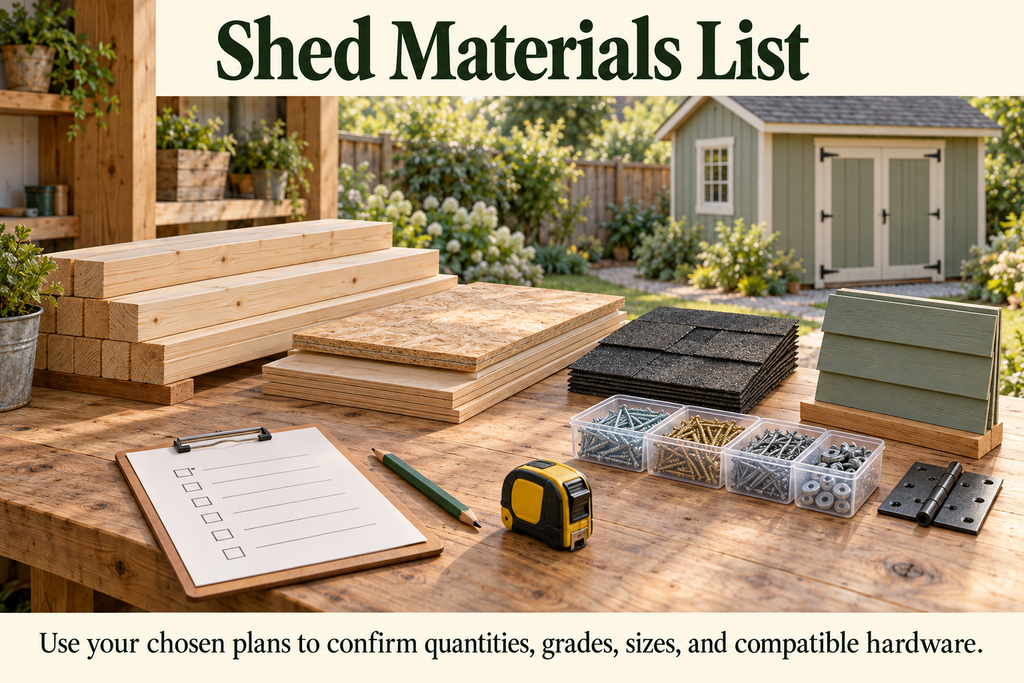
Why There Is No Universal Shed Materials List
Two sheds with the same footprint can require different materials.
One might have a concrete floor, while another uses a raised timber floor. They may have different wall heights, roof shapes, door openings, and structural requirements.
Even a change in window position can affect framing and finishing materials.
That means a generic “10 × 12 shed shopping list” should not be treated as suitable for every 10 × 12 design.
Before preparing your list, settle these decisions:
- Shed dimensions and intended use.
- Exact plan or kit model.
- Foundation and floor arrangement.
- Roof design and covering.
- Wall finish.
- Door and window configuration.
- Any approved changes to the original design.
If you are still deciding on dimensions, start with what size shed do I need?.
Materials List, Cut List, and Tools List: What Is the Difference?
These documents work together, but they answer different questions.
| List | What it tells you |
|---|---|
| Materials list | Which materials and products you need to purchase |
| Cut list | The dimensions and quantities of individual pieces |
| Tools list | The equipment needed to carry out the work |
| Hardware schedule | The specified fasteners, connectors, and fittings |
A cut list might identify several short pieces that can be cut from longer stock. Your shopping list needs to identify the stock you will actually buy.
Do not assume the lists are interchangeable. Read them alongside the drawings and assembly instructions.
Our guide to shed plans for beginners explains how to assess whether that information is clear enough to follow.
The Main Categories in a Shed Materials List
The checklist below is organized by building stage. Include only the items required by your selected design.
1. Foundation and Site Materials
Your foundation list depends on the support system specified for the shed.
Items to check may include:
- Specified aggregate or base materials.
- Edging or retaining components, where designed.
- Concrete and formwork materials, where applicable.
- Specified reinforcement.
- Piers, blocks, or other designated supports.
- Anchors and connection hardware.
- Required moisture-control materials.
Do not combine parts from different foundation systems simply because they appear in a general checklist.
First, confirm the arrangement using our shed foundation options guide and the requirements for your actual project.
2. Floor Framing and Floor Panels
If your shed includes a timber floor, look for a complete list of the members, panels, and connections shown in the drawings.
Depending on the design, this may include:
- Runners or skids.
- Joists and perimeter framing.
- Blocking.
- Specified floor panels.
- Connectors and fasteners.
Record more than the piece dimensions. Include the grade, treatment, panel rating, and other specifications stated in the plan.
If the shed uses a concrete slab as its floor, do not automatically add a timber floor package as well.
For more detail, see our upcoming guide to shed floor framing.
3. Wall Framing
Organize wall materials by assembly before combining them into one purchase list.
Check the drawings for:
- Studs.
- Top and bottom plates.
- Framing around doors and windows.
- Specified headers.
- Blocking and bracing.
- Required connections.
Mark each wall on your working list. This helps you trace an unclear quantity back to the drawing.
Pay particular attention to openings. A wall with double doors will not have the same framing list as a solid wall of equal length.
Our shed wall framing guide will cover how to read those assemblies.
4. Roof Framing
Use the roof arrangement shown in the selected plan.
Check for all specified framing members, supporting components, blocking, connectors, and fasteners. If the design calls for manufactured trusses, obtain the relevant package information rather than replacing it with a guessed lumber list.
Do not mix roof components from unrelated plans.
If a roof detail is unclear, resolve it with the provider before ordering or cutting materials.
5. Sheathing, Siding, and Trim
Keep structural panels and exterior finishes clearly identified.
Some designs use separate wall sheathing and siding. Others use a specified panel system serving more than one function. Buying both automatically could create an unnecessary expense; buying only one when both are required leaves the list incomplete.
Record:
- Product type and specification.
- Panel dimensions.
- Required quantity.
- Installation orientation where relevant.
- Matching trim and accessories.
- Specified fasteners and finishing requirements.
Label the intended use of each panel. Floor, wall, and roof panels should not be treated as interchangeable simply because their sheet dimensions match.
6. Roofing Materials
The roof covering is only part of the roofing order.
Review the selected system for items such as:
- Roof covering.
- Underlayment.
- Edge and flashing components.
- Ridge or cap components, where applicable.
- Specified fasteners.
- Ventilation components included in the design.
- Required compatible accessories.
Use the actual roof dimensions and the manufacturer’s coverage information.
The shed’s floor area is not a reliable substitute for roof area. Roof slope, overhangs, laps, and the product layout affect quantities.
Our planned shed roofing materials guide will compare the options and their associated components.
7. Doors, Windows, and Hardware
A complete door is more than its main panel.
Check whether you need to purchase or build the door, then list its specified framing, covering, trim, hinges, latch, handles, and other fittings.
For purchased windows, record the exact product and confirm that its required opening matches the plan.
Include the installation materials specified for those products. Do not leave weatherproofing details to a last-minute shopping trip.
8. Fasteners, Connectors, and Anchors
This category deserves its own section on the list.
Record the specified product, size, quantity, and any required coating or material. Where a connector calls for particular fasteners, use its installation requirements.
Compatibility matters, especially around preservative-treated wood and exposed conditions. Check the connector and fastener manufacturer’s guidance rather than assuming that any exterior screw is an acceptable replacement.
Our upcoming shed anchoring guide will explain the connection information to look for in your design.
9. Finishing Supplies
Check the instructions for the siding, trim, doors, and other exposed products.
Your list may include primer, paint, an appropriate sealant, and application supplies. Some products arrive primed but still require finishing.
Use the stated coverage rates and number of coats to estimate quantities. Check which surfaces and edges need treatment according to the product instructions.
Want drawings and a materials list to review together? Take a look at My Shed Plans. Confirm that the chosen design provides enough detail to identify the materials and connections before purchasing construction supplies.
Turn the Plan Into a Shopping List
A useful purchase list should let a supplier identify the requested item without guessing.
Use a format like this:
| Building stage | Material or product | Required specification | Quantity to buy | Status |
|---|---|---|---|---|
| Foundation | As specified in the foundation design | Record full details | From design | To confirm |
| Floor | Framing and panels | Sizes, grades, ratings, treatment | From plan | Not ordered |
| Walls | Framing members | Sizes, lengths, grades | From plan | Not ordered |
| Roof | Framing and roofing system | Complete specified products | From plan and product coverage | Not ordered |
| Connections | Fasteners and connectors | Exact approved specifications | From schedule | Not ordered |
| Finishes | Primer, paint, and accessories | Compatible products | From coverage instructions | Not ordered |
Keep unresolved items marked “to confirm.” An obvious question is better than a guessed specification hidden in a purchase order.
Check Quantities Before Ordering
Match the Correct Plan Version
Make sure the materials list, cut list, and drawings describe the same shed.
Check the dimensions, door arrangement, and any optional features. If you have revised the design, obtain an updated list for affected components.
Separate Required Pieces From Purchased Stock
A project may need several pieces of one length, but the supplier may sell longer boards.
Review the cutting layout before deciding how many stock lengths to buy. Allow for the cutting process and any unusable portions; do not assume that nominal lengths divide perfectly into finished pieces.
Check Packages and Coverage
Fasteners, roofing, and finishes may be sold in boxes, bundles, or containers.
Record both the required amount and the purchasable package quantity. Round up where necessary, and confirm whether the stated coverage already accounts for laps or other installation details.
Avoid Adding Waste Twice
Ask whether the supplied materials list already includes an allowance for waste.
Do not automatically add the same percentage to everything. Cutting waste, package rounding, spare hardware, and paint coverage are different issues.
Use the plan’s layout and product guidance to establish a sensible purchase quantity.
What If You Are Buying a Shed Kit?
Read the manual for the exact model before ordering additional supplies.
Some kit manuals list floor materials, roofing, or finishing products that must be purchased separately. Other packages include some of those items.
Create two columns:
- Included in the kit.
- Must be purchased separately.
Then compare both with the complete installation requirements.
This avoids buying duplicate materials while still missing an essential item.
If you are weighing up a kit against a build from plans, see build vs. buy a shed.
Keep Tools and Consumables on a Separate List
Materials become part of the building. Tools are what you use to assemble it.
Separating them makes shopping and budgeting easier. Include blades, bits, marking supplies, and other consumables on the tools-and-supplies list.
Review our tools needed to build a shed before the first delivery.
Then bring both lists into your shed-building budget so the project total includes more than construction materials.
Common Materials-List Mistakes
Buying Before the Design Is Settled
Changing the shed size or roof arrangement after ordering can leave you with unsuitable quantities or lengths.
Ordering by Dimensions Alone
Include required grades, treatments, ratings, and product specifications.
Forgetting the Small Components
Hardware, connectors, trim, and roofing accessories can interrupt progress just as easily as missing lumber.
Substituting Without Checking
A cheaper product is not automatically equivalent. Resolve proposed substitutions with the relevant designer or manufacturer.
Buying Everything Without a Storage Plan
Consider delivery timing and the manufacturer’s storage requirements. Make sure there is a suitable place for materials while they await installation.
Frequently Asked Questions
Can I use a materials list from another shed of the same size?
Not reliably. Roof shape, wall height, openings, floor design, and specifications may differ. Use the list for your exact design.
How many boards do I need to build a shed?
The number comes from the selected plan and cutting layout. Overall footprint alone is not enough to calculate a dependable order.
Should I buy extra materials?
Account for cutting waste and package quantities, but check whether the plan already includes an allowance. Avoid adding a blanket percentage without reviewing the individual items.
Can the lumber supplier check my list?
A supplier can help identify available products, stock lengths, package sizes, and prices. That does not automatically mean the supplier has verified the structural design.
Does a materials list include tools?
Sometimes, but many plans list tools separately. Check both before assuming you are ready to begin.
Build From a Complete, Checked List
A good shed materials list removes uncertainty from the shopping stage.
Start with the correct plan, organize the items by building stage, record the full specifications, and clarify anything missing. Then compare supplier prices using the same list.
Visit Beginner Shed Guide for more help preparing your first project.
Ready to choose a design and prepare your order? Explore My Shed Plans, review the available samples, and check the materials information for your preferred shed.
Resources
- Simpson Strong-Tie: Wood Connector and Fastener Corrosion Information — Guidance on selecting compatible hardware for the materials and exposure conditions.
- Example Shed Kit Assembly Manual Hosted by Lowe’s — An example showing separately required materials; use your own model’s manual for purchasing.
- Your selected shed plans — Use the matching materials list, cut list, drawings, and connection details.
- Product manufacturers’ installation instructions — Confirm specifications, coverage, accessories, storage, and finishing requirements.
Affiliate disclosure: We may earn a commission from purchases made through affiliate links on this page, at no additional cost to you.
Building disclaimer: This article is a shopping and planning checklist, not a structural materials specification. Use the quantities and specifications for your selected design, follow applicable local requirements, and obtain qualified help for unresolved construction details.