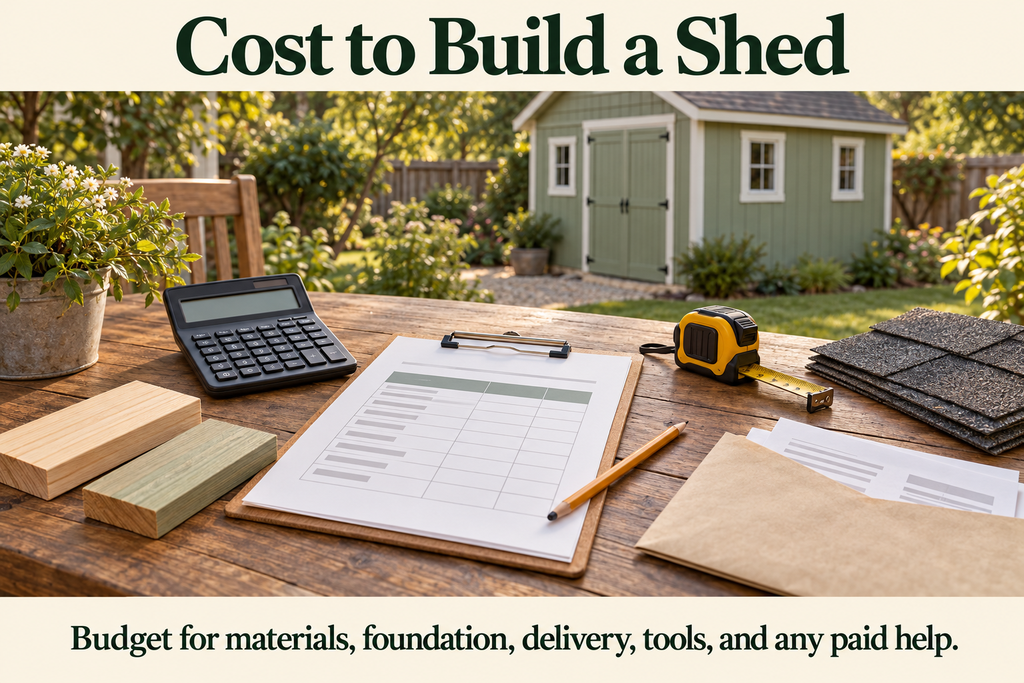
The cost to build a shed includes more than lumber and roofing. Your budget also needs to cover the base, fasteners, doors, finishes, delivery, and any tools or professional help the project requires.
That is why two sheds with the same dimensions can have very different final prices. A straightforward storage shed on an accessible site is a different project from a workshop with extra windows, electrical work, and substantial ground preparation.
The most useful estimate starts with a specific plan and a complete shopping list. This guide explains how to put those numbers together, spot missing expenses, and decide where you can simplify the project.
This article contains affiliate links. If you purchase through them, we may earn a commission at no additional cost to you.
Planning to build from drawings? Explore My Shed Plans. Check whether your chosen design includes a detailed materials list you can price locally before committing to the build.
What Is a Useful Starting Budget?
There is no single reliable price for every DIY shed.
As one reference point, The Home Depot’s shed installation cost guide lists an average of approximately $4,500 for materials, labor, and installation. That is an installed-shed benchmark from one provider’s guide—not a quote for your property or an estimate of DIY material costs.
For your own project, use this calculation:
Project budget = materials + site and foundation work + tools + delivery and taxes + paid help + applicable fees + contingency.
Keep the scope consistent. A price for a shed frame cannot be compared directly with a finished, installed building.
The examples below use US dollars. The sample budget is illustrative, not a current supplier quote or a national average.
Define the Shed Before Pricing It
Before opening a shopping cart, write down what you intend to build.
Record:
- The shed’s dimensions and intended use.
- The selected plan or design.
- The specified foundation and floor arrangement.
- Roofing and siding materials.
- Door and window requirements.
- Whether you will perform all the work yourself.
- Any shelving, workbench, or other additions.
If the size is still uncertain, start with our guide to working out what size shed you need.
A budget becomes more useful when the design stops changing. Otherwise, you may price one shed and gradually turn it into another.
The Main Costs to Include
1. Plans and Project Preparation
Include the cost of plans, if you are purchasing them, and any project-specific design assistance you need.
A paid plan is not automatically complete or appropriate for your site. Review sample drawings and confirm what is included.
Our guide to shed plans for beginners explains how to assess the drawings, instructions, and materials list.
Before buying materials, resolve unclear specifications. Guessing at missing details can lead to purchases you cannot use.
2. Site Preparation
Look at the actual building location before setting a budget.
Possible expenses include clearing the area, removing an existing structure, addressing uneven ground, and arranging access for materials.
An apparently inexpensive shed can become a more involved project if the proposed location requires substantial preparation.
Keep this as a separate budget line. It is easier to compare options when you can distinguish the building cost from the cost of making the site suitable.
3. Foundation and Floor
The base is easy to overlook when a shed photograph captures your attention.
Check whether the selected design includes a floor and exactly what foundation or support arrangement it requires. Do not assume a shed package includes everything needed beneath it.
Foundation suitability depends on the design, site conditions, loads, and applicable local requirements. Compare the options in our shed foundation guide before finalizing this part of the budget.
Avoid counting the same item twice. For example, check whether floor framing is already included in a kit or materials package.
4. Framing and Structural Panels
Use the plan’s specified quantities and material requirements to price the frame and panels.
Record the actual stock sizes you need to purchase. A cut piece and the board from which it is cut are not always the same length.
Check the list for:
- Floor framing, where applicable.
- Wall framing.
- Roof framing.
- Floor panels.
- Wall and roof sheathing.
- Specified connectors and fasteners.
Do not substitute a cheaper size, grade, or panel specification without confirming that it is suitable for the design.
For a closer look at organizing the shopping list, see our shed materials list guide.
5. Roofing, Siding, and Weatherproofing
Budget for the complete specified systems, not just the visible surface materials.
Depending on the design, the list may include underlayment, edge details, flashing, trim, fasteners, and finishes.
Check package coverage and purchase quantities carefully. A supplier may sell a product in packs, rolls, or bundles that do not match your exact requirement.
Price the quantity you must buy, while recording any useful leftovers separately.
6. Doors, Windows, and Hardware
A door budget should account for more than the door itself.
Check the design for hinges, handles, latches, trim, and any other specified components. If windows are included, account for their installation and finishing materials as well.
Before reducing the doorway to save money, check that your largest equipment will still fit comfortably.
Decorative additions can be reconsidered more easily than a doorway that is essential to using the shed.
7. Tools and Consumables
Make a tools list and mark what you already own, what you can borrow, and what you need to rent or buy.
Include consumables such as suitable blades, drill bits, and other supplies required for the work.
If a tool will be useful for many future projects, you may regard it as a longer-term purchase. It still affects the cash needed to complete this shed.
Our shed-building tools checklist will help you organize this part of the estimate.
8. Delivery, Taxes, and Paid Help
A materials subtotal is not necessarily the checkout total.
Add delivery charges and applicable sales tax. Consider whether you will need more than one delivery and whether rental equipment has collection or transport charges.
If you plan to hire help for any stage, obtain a quote with a clear scope. Confirm what materials, preparation, and cleanup are included.
An Illustrative Shed Budget
The following example shows how to organize a budget. The amounts are invented planning figures, not observed prices for a particular shed size or specification.
| Budget item | Illustrative allowance |
|---|---|
| Plans | $50 |
| Site preparation | $250 |
| Foundation and floor materials | $650 |
| Wall and roof framing | $700 |
| Wall sheathing, siding, and trim | $600 |
| Roof sheathing and roof covering | $450 |
| Door and hardware | $250 |
| Fasteners, connectors, and finishing supplies | $300 |
| Tool rental and consumables | $150 |
| Delivery and sales tax | $300 |
| Subtotal | $3,700 |
| Illustrative contingency of 15% | $555 |
| Example planning total | $4,255 |
This example assumes the owner supplies the labor. It excludes electrical work, insulation, plumbing, permit fees, and professional design services.
Replace each allowance with actual prices for your chosen project. Add excluded items when they apply.
The 15% contingency demonstrates the calculation; it is not a guarantee that every project’s unexpected costs will fit within that amount.
Want a design to use for your own estimate? Take a look at My Shed Plans, then price the specific plan’s materials locally. A collection’s purchase price is separate from the cost of building any shed within it.
Why Cost per Square Foot Can Be Misleading
Cost per square foot can help compare similar projects, but only when the included work is comparable.
Imagine two hypothetical estimates:
- An 80-square-foot shed priced at $3,200: $40 per square foot.
- A 120-square-foot shed priced at $4,200: $35 per square foot.
The second has a lower cost per square foot but still requires $1,000 more overall.
These figures are mathematical examples, not market estimates.
Before using this comparison, check whether both prices include the foundation, roofing, finishes, delivery, and labor. Also compare specifications. Different materials and construction details can make the headline numbers misleading.
Is Building a Shed Yourself Cheaper?
Doing the work yourself can reduce the amount you pay for labor. It does not automatically make the complete project cheaper.
You may need tools, rental equipment, extra deliveries, or paid assistance for unfamiliar stages. Errors and replacement materials can also affect the result.
Compare three complete options:
| Option | What to include in the comparison |
|---|---|
| Build from plans | Materials, tools, delivery, preparation, fees, and any paid assistance |
| Assemble a kit | Kit price, excluded materials, base, delivery, tools, and assembly help |
| Buy an installed shed | Quoted building, installation scope, site work, upgrades, and exclusions |
For the full decision, read our build vs. buy a shed comparison.
Also consider your time. You do not have to assign it a dollar value, but you should decide whether the work fits your schedule and interests.
How to Reduce Costs Without Undermining the Build
Settle the Layout First
An unnecessary increase in size adds more than floor area. It can change multiple material quantities and other project requirements.
Choose enough space for your belongings and access, then resist enlarging the design without a clear reason.
Simplify Optional Features
Review decorative trim, additional windows, and other nonessential features.
Keep the features needed for access and the intended use. Postpone optional interior fittings where practical.
Compare the Same Materials List
Send an identical list to suppliers so you can compare equivalent quantities and specifications.
Include delivery and tax in the comparison, and ask about returns for unused eligible materials.
Plan Purchases Around the Work
A well-organized order can help avoid repeated trips and delivery charges. Check that you have suitable storage for materials before arranging an early delivery.
Keep Required Details in the Budget
Do not reduce costs by omitting specified connections, protection, or structural components. If the complete design is beyond your budget, reconsider its size or features.
Our upcoming guide to the cheapest way to build a shed focuses on practical ways to simplify a project.
Costs Beginners Often Miss
Before accepting the total, check for:
- Removal and disposal of an old shed.
- Materials sold only in full packages.
- Rental delivery or collection charges.
- Door hardware and specified connectors.
- Paint preparation and finishing supplies.
- Storage fittings needed to make the shed usable.
- Applicable approval or design fees.
- Extra work required by the intended site.
Ask your local building or planning office about your proposed project before committing. Our shed permit guide explains the questions to prepare; requirements must be confirmed locally.
Frequently Asked Questions
How much does it cost to build a 10 × 12 shed?
The dimensions alone are not enough to produce a reliable estimate. Select a design, price its materials, and add site work, delivery, taxes, tools, and any paid labor or fees.
Can I build a shed for less than an installed model?
Possibly, particularly if you already have suitable tools and can perform the work. Compare equivalent buildings and include every expense before deciding.
Does a shed kit include everything?
Check the individual product’s inclusions and installation manual. Verify the floor, foundation requirements, roofing, finishes, hardware, and delivery arrangements rather than assuming they are included.
Should I include my own labor in the budget?
For a cash budget, record the amounts you will actually pay. For a build-versus-buy decision, also consider the time you will spend and whether you would prefer to pay someone else.
How much contingency should I allow?
Choose an allowance based on the uncertainties remaining in your project. The sample budget uses 15% only to illustrate the calculation. Resolve major unknowns through inspection and quotations instead of relying on a percentage to cover them.
Build Your Budget Around a Real Plan
A useful shed budget answers a practical question: What will it take to finish this particular shed on this particular site?
Choose the size, settle the design, price a complete materials list, and identify the work outside that list. Record the assumptions so you can see what changes when you compare options.
Visit Beginner Shed Guide for more help planning your first project.
Ready to choose a design and price it? Explore My Shed Plans. Review the available samples and current offer, then check the suitability and completeness of your chosen plan before buying materials.
Resources
- The Home Depot: Cost to Install a Shed — Installed-shed cost reference and examples of additional expenses.
- Lowe’s: Storage Shed Buying Guide — General guidance for comparing storage sheds.
- Local suppliers and contractors — Obtain written prices for the exact materials and work your project requires.
- Your local building or planning office — Confirm applicable requirements and fees.
Affiliate disclosure: We may earn a commission from purchases made through affiliate links on this page, at no additional cost to you.
Building and pricing disclaimer: This article provides general planning information. The example budget is illustrative, and actual costs depend on location, specifications, site conditions, and the work included. Follow applicable local requirements, your selected plan, and manufacturers’ instructions.